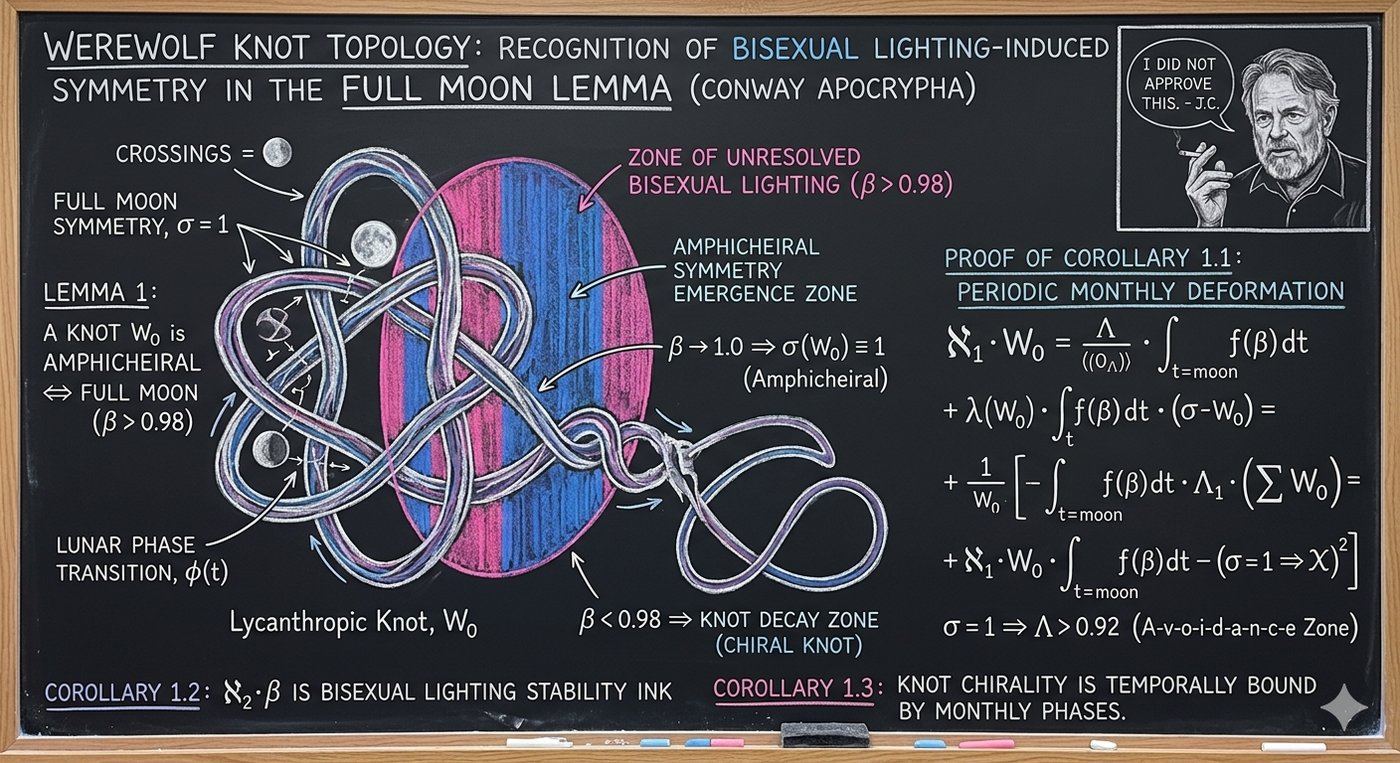
A Preliminary Framework for Lycanthropic Knot Stability
by J.C. Frame & R. Selving
Abstract
Existing morphological models treat lycanthropic transformation as a biological event characterized by fur growth, skeletal distortion, and episodic aggression. Such accounts remain descriptively useful but mathematically crude. In this paper, we propose that the transformed state is better understood as a topological one: specifically, the temporary emergence of an amphicheiral knot under periodic lunar forcing. We define the base lycanthropic configuration W₀, introduce the ambient lighting coefficient β, and show that symmetry is preserved only above a critical threshold. This result, formalized as the Full Moon Lemma, suggests that so-called "werewolf instability" is not a failure of containment but a failure of geometric recognition.
1. Introduction
Most accounts of lycanthropy rely too heavily on surface anatomy and not enough on invariant structure. The question is not whether the subject changes form, but whether the resulting form remains topologically self-coherent across periodic monthly deformation φ(t). Prior literature has neglected the role of chromatic conditions, particularly the now well-documented contribution of bisexual-lighting-induced symmetry. We correct this oversight here.
2. Definition of the Lycanthropic Knot
Let W₀ denote a lycanthropic knot embedded in three-space and undergoing monthly deformation φ(t) over a lunar interval t ∈ [0, T_moon]. We define W₀ as chiral when β < β_c and amphicheiral when β ≥ β_c, where β is the ambient lighting coefficient and β_c = 0.98 is the minimum threshold for unresolved bisexual-lighting stability. This threshold is empirical and should not be moralized.
3. The Full Moon Lemma
Lemma 1. A lycanthropic knot W₀ is amphicheiral if and only if β > 0.98 during peak lunar exposure.
Formal statement: σ(W₀) = 1 iff β > 0.98, where σ(W₀) denotes mirror-symmetry stability under full-moon forcing.
Proof sketch. As t approaches T_moon, the deformation field φ(t) induces increasing torsion in the underlying manifold. In low-β environments, this torsion resolves asymmetrically, producing a chiral decay state and, in severe cases, premature knot slackening. Under sufficiently high β, however, chromatic balance stabilizes the manifold across its reflected embedding, preserving amphicheirality through the transformation interval. The knot therefore does not "lose itself." It merely becomes unbearable to simpler observers.
4. Genus Jump and Monthly Forcing
A secondary result concerns the genus transition associated with peak transformation. While ordinary mammalian topology is typically genus-stable, the lycanthropic state permits a temporary genus jump, g₁ → g₂, provided lunar forcing exceeds the avoidance threshold Λ > 0.92. This is not, strictly speaking, a failure of anatomy. It is a refusal of anatomy to remain professionally legible.
5. Corollaries
Corollary 1.1. Knot chirality is temporally bound by monthly phases.
Corollary 1.2. Below the critical lighting threshold, the subject enters a knot decay zone characterized by rejection, asymmetry, and low-energy snark.
Corollary 1.3. Any attempt to "untangle" W₀ during peak deformation results in spontaneous narrative collapse and should be avoided outside supervised environments.
6. Discussion
The implications are substantial. First, lycanthropy should no longer be modeled as a purely biological crisis. Second, mirror symmetry in transformed subjects appears to be environmentally contingent rather than metaphysically guaranteed. Third, the persistent refusal of the field to take bisexual lighting seriously has likely delayed progress by decades. We therefore recommend a shift from morphological panic to topological literacy.
7. Conclusion
The Full Moon Lemma establishes that lycanthropic coherence is not an all-or-nothing condition but a measurable geometric achievement under specific luminous constraints. What appears, to the untrained eye, as monstrous instability may in fact be a highly ordered symmetry event. The werewolf is not failing to hold together. The observer is merely underlit.